Best Security Cameras for Business Entrances and Exits
The optimal camera for a business entrance or exit is dependent on various factors, including the purpose of the camera, lighting conditions, the viewing distance, the configuration of the door, and the priorities of the business. These priorities may include identification, wide-area awareness, or a combination of both.
In the context of commercial surveillance, the design of entrances and exits is of paramount importance. These are the points at which almost all individuals who interact with a business pass through.
- Employees
- Customers
- Visitors
- Vendors
- Contractors
- Deliveries
- After-hours access
The goal is not simply to point a camera at a door. The camera should provide useful coverage of people approaching, entering, or leaving the property. Many businesses have cameras installed above their main entrances, yet they are unable to identify individuals in the footage due to inadequate angles, lighting, or lens positioning.
Professional video-security guidance recommends positioning exit cameras to obtain an unobstructed view of people leaving a facility while avoiding direct bright-light sources that can reduce image quality.
Why Are Business Entrances and Exits So Important for Video Surveillance?
Know Who Is Entering the Property
The purpose of the entry coverage documentation is to provide a record of employee arrivals, customer traffic, visitor activity, and contractor access. It establishes a baseline of normal activity and makes unusual activity easier to spot.
Document Who Is Leaving
Exit coverage is often overlooked, but it is frequently more valuable. This system can assist in the effective management of incidents by facilitating the accurate documentation of events. It enables the recording of crucial information such as the items carried by a person as they exit the premises and the direction they are heading in.
Monitor After-Hours Activity
Entrances are the primary points of access for unauthorized entry, employees arriving outside of standard schedules, and activity around closed businesses. Cameras at these points provide the clearest picture of what happens when nobody is on site.
Create a Visual Record of Incidents
It is important to note the distinction between installing a camera and actually having usable footage. A visual record is only useful if the resolution, framing, and lighting produce an image that can be worked on weeks later.
What Type of Camera Is Best for a Business Entrance?
Dome Cameras
Dome cameras are particularly well-suited to interior entrances, reception areas, office buildings, and retail environments. The housing is discreet and blends into most ceilings, and the enclosed design makes the camera harder to tamper with or redirect.
Bullet Cameras
Bullet cameras are a popular choice for exterior doors, building approaches, side entrances, and loading areas. The form factor supports longer lenses and clearly indicates that an area is monitored.
Turret Cameras
Turret-style cameras offer a compact housing design with flexible aiming capabilities. These cameras are particularly useful in situations where precise angles are required at entrances, and they are not affected by internal reflections that can occur with dome cameras when using infrared at night.
Wide-Angle Cameras
Wide-angle and multi-sensor cameras provide broader coverage around lobbies, building entrances, exterior approaches, and large doorways, capturing an entire entry area with fewer devices.
What Camera Features Matter Most at Business Entrances and Exits?
High-Resolution Video
In professional photography, resolution is paramount when it comes to capturing identifying details rather than movement. The following details will be of use:
- Facial detail
- Clothing
- Objects
- Vehicle information
- General activity
It is important to note that resolution alone does not guarantee a usable image. When pixels are spread across a scene that is too wide, the subject is rendered too small to identify.
Wide Dynamic Range
The wide dynamic range is advantageous when bright outdoor light enters through glass doors. In the absence of this feature, an individual entering from daylight is often rendered as a silhouette against a blown-out background.
Low-Light and Night Vision
The functionality of exterior entrances, employee doors, and businesses operating after dark is contingent on the low-light performance of the system. Infrared illumination and low-light sensors determine whether nighttime footage is usable or merely proof that something moved.
Appropriate Field of View
It is important to note that a wider aperture does not necessarily guarantee superior image quality. A camera that covers a large area can capture context, but this may result in faces being rendered too small to identify. The field of view should be matched to the purpose of the camera at each location.
Motion and AI Analytics
Modern commercial cameras support:
- Person detection
- Vehicle detection
- Line crossing
- Intrusion detection
- Activity alerts
Analytics should be configured around the location and security objective. A rear employee door might warrant after-hours person detection, while a busy retail entrance would generate constant alerts from the same setting.
Where Should Cameras Be Positioned Around a Business Entrance?
Camera Facing the Door
The camera should provide a useful view of people entering or leaving, rather than only capturing the top of someone’s head. One of the most common errors made when positioning these signs is mounting them too high and aiming straight down.
Camera Covering the Approach
A wider view showing people approaching the entrance captures behavior before entry, which often matters more than the moment of entry itself.
Camera Covering the Exterior
For outdoor doors, coverage should extend to:
- Sidewalk approaches
- Parking areas
- Door surroundings
- Exterior walls
Consider a Two-Camera Approach
In some cases, one camera is unable to deliver the necessary level of both wide-area context and identification-level detail at the entrance. A commercial camera-placement guide recommends that both broader approach coverage and closer views around entrances be taken into consideration. The trade-off is resolved by pairing one camera to provide context with a second positioned tightly on the doorway.
How Should Businesses Handle Glass Doors and Difficult Lighting?
One of the most challenging aspects of surveillance in any building is the management of entrances, largely due to the effects of light.
Bright Outdoor Light
The presence of daylight behind a subject can result in the occurrence of backlighting. The camera is set to expose for the bright background, which results in the person becoming a dark shape.
Glass Reflections
Glass doors and storefronts can have a detrimental effect on image quality by reflecting interior lighting, exterior signage, and the camera itself.
Nighttime Contrast
After nightfall, the issue is reversed. The combination of a brightly lit interior and a dark exterior creates significant contrast within a single frame, presenting a challenge to the camera’s ability to accurately capture the scene.
Camera Position and WDR
It is important to note that adjusting the mounting angle so that the camera is not directed towards a light source, in combination with correctly configured WDR settings, will produce far more usable footage than resolution upgrades alone. In the context of a glass entrance, position and configuration tend to be more significant than camera specifications.
Which Cameras Are Best Suited to Exterior Business Entrances?
Weather-Resistant Cameras
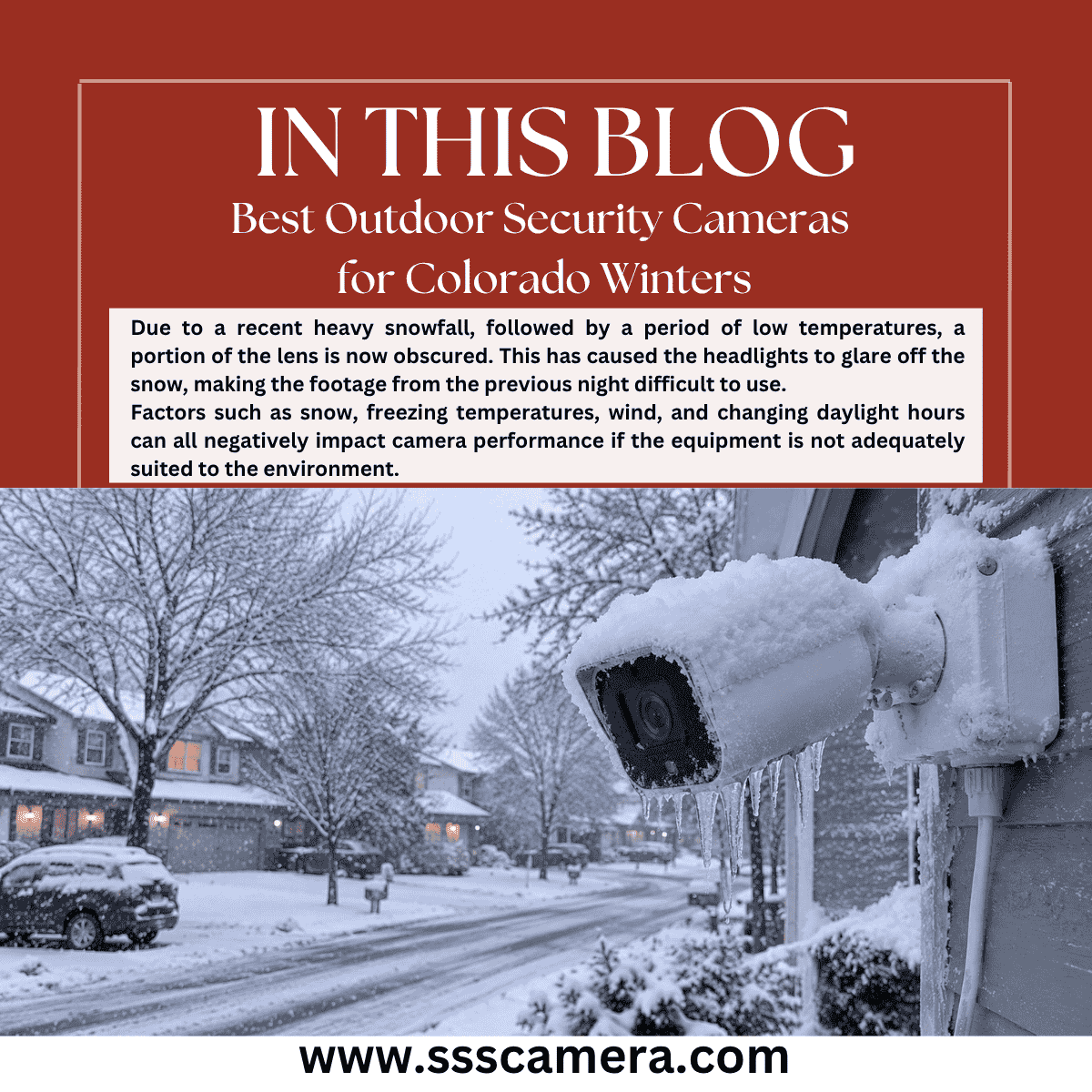
Outdoor cameras require housings that are rated for exposure. In the Colorado Front Range, temperature variations, snow, wind-driven moisture, and intense sunlight all have a negative impact on the lifespan of hardware that has been designed for indoor use.
Infrared Night Vision
Infrared illumination provides visibility at exterior doors, parking approaches, and unlit building sides after dark. Learn more about our night vision options.
Vandal-Resistant Housing
Cameras installed within reach may require reinforced housings and tamper-resistant mounting, particularly at rear and side doors.
Wide-Area Coverage
Larger entrances, driveways, and employee parking areas benefit from wider coverage or additional camera positions, since a single narrow view can leave gaps that people can walk through.
Should Businesses Put Cameras at Every Entrance and Exit?
As part of the surveillance plan, it is essential to evaluate every entrance and exit. However, the number and type of cameras required is dependent on the building layout and security objectives.
Doors worth evaluating include:
- Main entrances
- Rear exits
- Employee entrances
- Emergency exits
- Loading doors
- Side doors
- Garage or vehicle entrances
It is important to pay particular attention to less visible doors. Main entrances are usually well lit, visible from the street, and busy with witnesses. Rear and side doors are usually the opposite, which is precisely why they attract attention after hours.
Can Entrance Cameras Work with Access Control?
Access Control Determines Who Is Authorized
Access control systems manage credentials and permissions, determining whether a given person is permitted to enter a designated area at a specific time.
Cameras Show What Happened
Video provides context that a credential log cannot: who was present, how many people entered, and what took place at the door.
Integrated Systems Connect the Two
When the systems are integrated, an access event can be reviewed alongside the relevant video footage, transforming a line in a log into a reviewable clip.
This is especially useful for:
- Unauthorized access
- Tailgating concerns
- After-hours entry
- Lost credentials
- Incidents related to the door
Which Security Camera Brands Are Available for Business Consideration?
Uniview
Uniview offers a comprehensive commercial video surveillance line with dome, bullet, turret, and wide-angle configurations, plus analytics options suited to entrance monitoring.
Digital Watchdog (DW)
Digital Watchdog is a trusted provider of professional surveillance cameras and video management software, offering advanced options for challenging lighting conditions.
Exacq
Exacq is a specialist in video management, providing businesses with a centralized system for recording, reviewing, and accessing footage remotely across multiple cameras or locations.
LTS
LTS offers a range of commercial camera options, spanning various resolutions and form factors, to suit a variety of business environments and budgets.
The most appropriate camera is determined by factors such as entrance, lighting, distance, coverage objective, and overall system design, rather than brand preference alone.
How Can Security Surveillance System Help with Business Entrance Security?
The company’s approach to the design of security surveillance systems is to consider the issue of entrance coverage as a design problem rather than a matter of purchasing hardware. That process includes:
- Site evaluation
- Camera placement
- Indoor and outdoor entrances
- Image quality
- Nighttime coverage
- Recording
- Remote viewing
- Integration with access control measures
SSS collaborates with businesses in Denver, Aurora, Boulder, Broomfield, Colorado Springs, Fort Collins, Lakewood, and neighboring communities. The company conducts on-site evaluations of each entrance, followed by the recommendation of suitable equipment.
Frequently Asked Questions Regarding Business Entrance and Exit Cameras
About Security Surveillance System
Security Surveillance System is a locally owned, licensed security camera company based in Denver, CO. Since 2006, we have installed hundreds of commercial and residential security systems across Colorado, including video surveillance, access control, intercom, and burglar alarm systems, backed by a one-year warranty on all parts and labor for full installations.