From Analog to AI: 20 Years of Security System Evolution in Colorado
What is the connection between a boutique retail store in Denver in 2024 and a warehouse in Colorado in 2004? Both required security protection; however, their approaches differed significantly in terms of technology, costs, capabilities, and compliance requirements.
Over the past 20 years, Colorado’s security surveillance systems have changed so drastically that the industry barely resembles its former self. This evolution is not only fascinating but also directly impacts the decisions of homeowners, property managers, and business owners in Denver and the Front Range. Understanding these changes is essential for making informed choices today.
What Did Security Systems Look Like in Colorado 20 Years Ago?
In the early 2000s, analog CCTV was the only type of security surveillance available. This system relied on bulky DVR units that recorded low-resolution video onto magnetic tape or early hard drives. These units were connected using coaxial cables that ran through the walls. A typical business setup in Denver would feature four to eight fixed cameras, a physical alarm panel linked to a monitoring center, and a padlocked equipment room where tapes were swapped weekly.
There were serious restrictions. The blurry footage was frequently unsuitable for use in court. There was no remote access; you had to drive there to check on your property. Storage was vulnerable and physical. Additionally, the evidence would be lost if the DVR and the equipment it was meant to safeguard were taken.
Security for residential clients was considerably simpler: a yard sign from the monitoring provider, a few window sensors, and a keypad alarm.
How Did the Transition to IP Cameras Affect Everything?
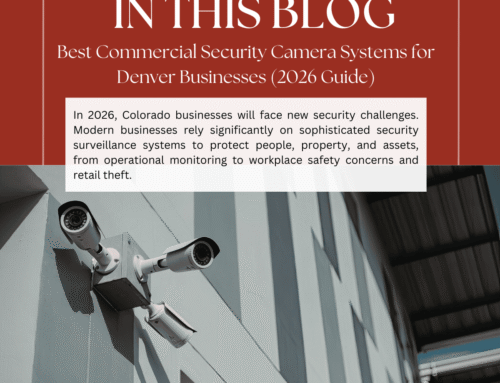
The first significant change occurred between 2009 and 2014 during the IP revolution. The introduction of network-connected cameras gave Colorado businesses visibility that they had never had before. The game was completely altered by HD resolution, remote browser access, and NVR (network video recorder) systems that could save weeks’ worth of film on encrypted hard drives.
Industry data indicates that from 2010 to 2018, the global IP camera market grew at a compound annual growth rate of over 14%. This rapid growth led to frequent upgrades in Denver, particularly in sectors such as property management, retail, and warehousing. Camera systems used for business security have transitioned from being passive recording devices to active management solutions.
We witnessed this shift personally at Security Surveillance System. Clients in Denver who had previously considered grainy footage to be “good enough” suddenly demanded 4K resolution and the option to view live footage from their smartphones. This demand completely changed the way we planned and set up each system.
What Role Did Smart Integration Play Between 2015 and 2020?
The convergence era began during this time. Security was integrated into a single building management ecosystem and ceased to be a separate role. Property owners in Colorado’s expanding commercial real estate market, especially in Denver’s LoDo, RiNo, and Cherry Creek areas, started requesting integrated security systems that combined:
- Intelligent motion detection in video surveillance
- Systems for controlling access for companies using mobile credential readers
- Access control via intercoms at entry points
- Smart locks for residences and businesses
- Instantaneous mobile warnings via cloud-based alarm panels
Installing biometric access systems became more than simply a curiosity. Fingerprint and facial recognition scanners started to take the place of key fob systems for business clients in Denver’s tech district. In Colorado, buzzer panels were replaced by video intercom systems and IP-based intercoms in apartment complexes and multi-tenant residential buildings.
During this period, Colorado’s compliance regulations became more stringent. Retail establishments were required to maintain documented access logs and video retention practices as part of the PCI DSS regulations. Additionally, healthcare facilities in the Denver metro area had to align their surveillance procedures with the physical security requirements outlined in HIPAA. Consequently, access control audit trails transitioned from being simply a feature to becoming a legal necessity.
How has AI changed Colorado’s security surveillance since 2020?
Artificial intelligence has completely altered the definition of security, not merely enhanced security cameras.
A person lingering close to a restricted area can be identified by modern AI-powered surveillance systems before an event. They differentiate between a stray animal, a car, and a human. They create automated incident reports, identify odd behavioral trends, and notify employees in real time.
There are practical ramifications for Denver businesses:
- Preventing retail losses: Without the need for continuous human supervision, AI-driven systems use retail store security cameras to assess user movement patterns and identify anomalous behavior close to expensive items.
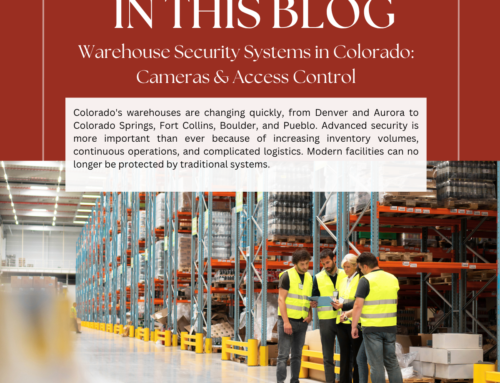
- Industrial and warehouse security: Denver’s warehouse security systems now include perimeter detection algorithms, which sound an alert as soon as an unwanted car or person enters a designated zone, day or night.
- Large-scale remote monitoring: A single operator can keep an eye on dozens of sites at once with cloud-based commercial security monitoring systems. Previously necessary on-site security can now be managed remotely, saving enterprise clients an estimated 30–40% on operating expenses.
- Commercial access control development: Building managers now can grant, revoke, or change entrance rights from any device and from anywhere, thanks to cloud-based access control solutions. These systems automatically log real-time access control audit trails, ensuring compliance with industry standards.
By 2028, the market for commercial security systems is projected to reach $78 billion, primarily driven by cloud migration and the utilization of AI analytics.
2024 and Beyond: Industry Trends Affecting Colorado Security
Zero-trust physical security
Physical security is adopting a zero-trust architecture in the same way that cybersecurity did. Each access event is cross-referenced, recorded, and validated. Without ongoing validation, no credential can be trusted indefinitely.
Platforms for unified security
Businesses in Denver are increasingly looking for a single dashboard that controls intercom systems, access control, video surveillance, and alarm monitoring. Security that is compartmentalized is becoming outdated.
Retrofit-friendly and wireless systems
Denver’s demand for wireless security cameras has skyrocketed, especially for older buildings where installing new cable would be prohibitively expensive. The inconvenience associated with traditional deployments is eliminated with wireless camera installation.
Eco-friendly and energy-efficient security systems
The security sector in Colorado has been influenced by its sustainable culture. Energy-efficient security systems, low-power wireless sensors, and solar-powered exterior cameras are increasingly common in both new construction and retrofit projects.
Combining smart homes and businesses
Smart home security in Denver is already part of commercial-grade thinking. These days, homeowners demand enterprise capabilities in residential packages, such as cloud backup, AI warnings, remote access, and smart lock integration.
What Impact Does Colorado Compliance Have on Your Current Security System?
Colorado’s approach to data privacy and physical security compliance has gradually become more robust. Businesses using surveillance systems that use facial recognition or biometric data are directly impacted by the Colorado Privacy Act (CPA), which went into effect in 2023.
For Denver firms, the following are important compliance considerations:
- Video retention guidelines must comply with industry norms and any relevant sectoral or state laws.
- Access control audit trails need to be kept up to date and accessible.
- Access control systems’ biometric data is subject to stricter privacy regulations.
- Policies for employee monitoring must be revealed and recorded.
Businesses of any significant scale now have no choice but to work with a professional security company in Denver that is knowledgeable about both the technical and regulatory situations. In Denver, security audits and security system compliance services are already commonplace elements of competent security planning.
FAQ: Colorado’s Evolution of Security Systems
Q1. What distinguishes analog security systems from modern ones the most?
AI-powered detection, cloud storage, remote access, and connection with smart devices and access control are all features of contemporary systems. Low-resolution video was captured locally by analog devices, which lacked intelligent alarms and distant visibility.
Q2. How can I tell if my Denver business requires a security system upgrade?
A security system upgrade is most definitely necessary if your system is older than five to seven years, employs coaxial cables and DVR recording, does not have remote access, or is not integrated with access control or alarm systems.
Q3. What is cloud access control, and why is it important?
You may regulate who enters your building from anywhere at any time using cloud access control. It enables mobile credentials, creates automatic audit trails, and expands with your company without the need for on-site server hardware.
Q4. Do wireless security cameras have the same level of dependability as wired ones?
Modern wireless security cameras in Denver are quite dependable for the majority of business and residential uses, especially with redundant network infrastructure. For retrofit installations where cabling is impractical, they are particularly useful.
Q5. What Colorado compliance standards apply to security systems?
The Colorado Privacy Act, PCI DSS (retail), HIPAA-adjacent physical security standards (healthcare), and general data retention best practices are examples of pertinent frameworks, depending on your business. Your particular responsibilities can be determined by a professional security audit in Denver, Colorado.
Q6. How much time does it take to install a security system professionally?
In one to two days, the majority of home installations are finished. Depending on scale, integration complexity, and whether access control system installation is included, commercial security system installations can take anywhere from one day to several weeks.
Conclusion
Colorado has made two decades of progress while maintaining one constant.
The development of security surveillance systems in Colorado over the past 20 years is a tale of unrelenting growth, from grainy VHS tapes to AI-powered behavioral analytics, from padlocked equipment rooms to cloud dashboards accessible from a smartphone in Telluride.
The core objective remains the same: safeguarding the individuals, resources, and activities that are most important to you. Whether you oversee a home in the mountains of Denver, a retail storefront in Cherry Creek, or a warehouse in Commerce City, the security environment in 2024 provides capabilities that would have appeared unthinkable ten years ago.
Businesses and homes that view security as a living, dynamic system that is routinely audited, expertly maintained, and carefully linked with the technologies they rely on on a daily basis are the ones that prosper in this setting.
Are You Prepared to Update Your Denver, Colorado Security System?
For many years, Security Surveillance System has provided professional-grade surveillance, access control, and integrated security solutions that are customized to meet your unique needs in Colorado homes and businesses.
Our staff is prepared to assist you whether you’re beginning from scratch, it’s time for a security system upgrade, or you just need a professional security consultation in Denver to understand your alternatives.
Speak with our security professionals right now. Find out what a cutting-edge, AI-ready security system looks like for your Denver, Colorado home by scheduling a free consultation.
Get a security consultation right now.