Video Monitoring vs Surveillance: Which Is Right for Colorado Businesses?
Installing security cameras is an important step for many business owners in Colorado who want to protect their property. Security cameras provide peace of mind, enhance visibility, and offer documentation of events. However, as security needs evolve, a common question arises:
Should businesses consider video monitoring, or is basic video surveillance sufficient?
At Security Surveillance System, we specialize in providing commercial security camera systems and video equipment to businesses in Colorado. We frequently assist clients who ask about video monitoring, even though we do not offer this service ourselves. If companies choose to work with a third-party video monitoring service, our role is to help them understand the differences, install the appropriate camera systems, and ensure that their infrastructure is compatible.
This guide outlines the key distinctions between video surveillance and video monitoring, helping business owners determine when each option is most appropriate.
Understanding Video Surveillance
The majority of commercial security systems are built on video surveillance.
Typical components of a surveillance system are
- Security cameras are positioned all over a building
- Cloud-based or local video recording
- Video saved for future examination
The majority of surveillance systems are reactive. They document events, enabling entrepreneurs to:
- Review incidents after they occur
- Support insurance claims with proof.
- Address disagreements or liability concerns
- Use visible cameras to deter crime
In Colorado, video surveillance by itself offers enough security for a large number of small and mid-sized enterprises, particularly when sites are occupied during business hours.
What Is Video Monitoring?
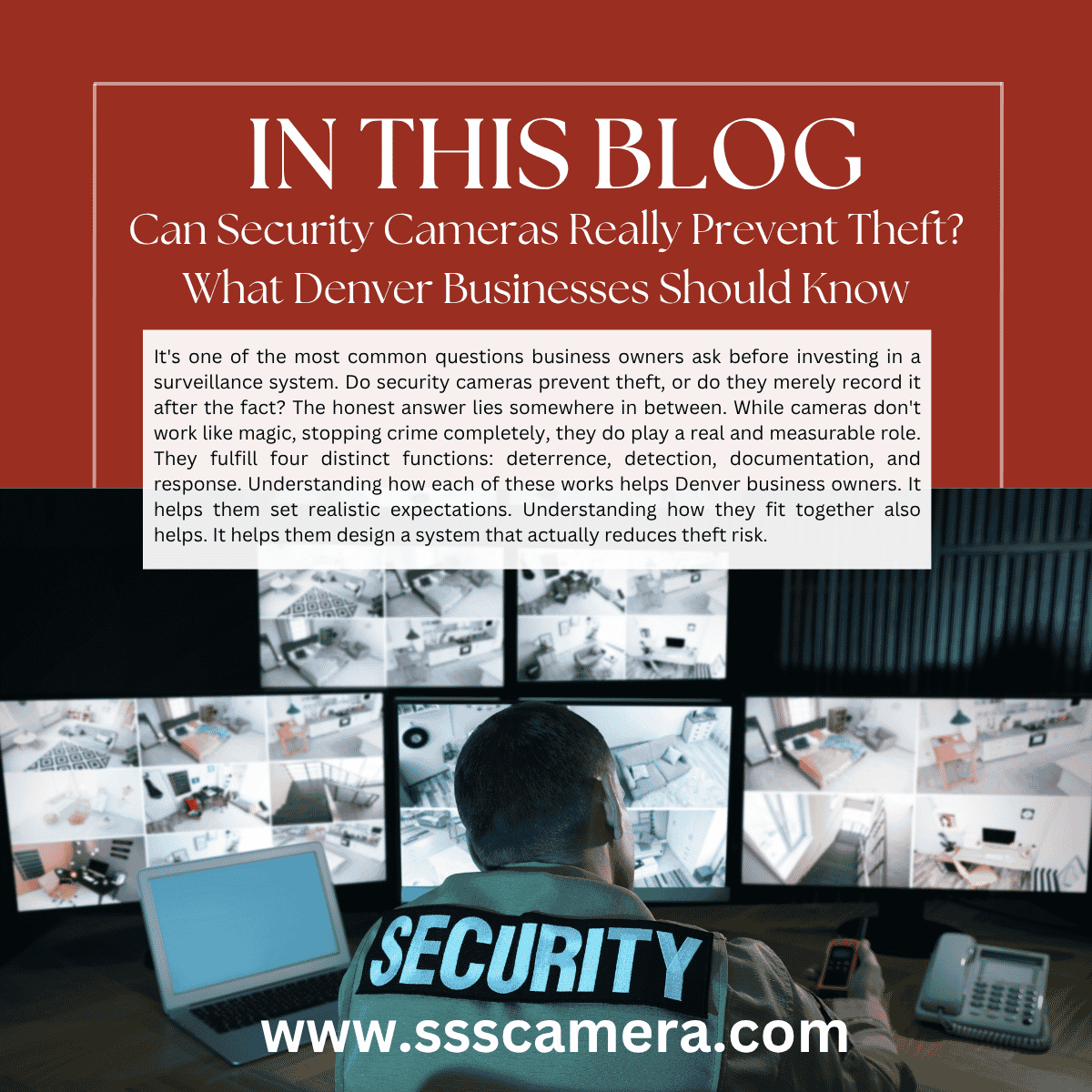
A human reaction layer is added to camera systems through video monitoring.
Cameras are linked to a monitoring center run by a third-party service rather than having their footage examined after an occurrence. Trained staff members watch live video and execute escalation protocols when motion or predetermined events take place.
Typically, video monitoring consists of
- Live or event-based monitoring
- Alarm verification
- Alerts in real time
- Reporting to authorities or business associates
Crucial explanation:
A video monitoring center is not run by Security Surveillance System. Independent third-party businesses that specialize in operations monitoring provide monitoring services. The design, installation, and technical support of camera systems are the exclusive responsibilities of Security Surveillance System.
Why the Difference Matters for Colorado Businesses
Many companies believe that video surveillance is only an “add-on feature.” In actuality, monitoring necessitates:
- The right positioning of the camera
- A dependable network infrastructure
- Hardware that is suitable for monitoring
- Explicit response procedures
- Adherence to privacy laws
Even skilled monitoring services could be useless without the proper basis. Because of this, knowing the difference up front helps organizations avoid unneeded expenses or unfulfilled expectations.
When Video Surveillance Is Sufficient
Not every company requires video monitoring.
Surveillance-only systems are frequently effective for:
- Regularly staffed offices
- Companies that are only open throughout the day
- Compact establishments with little risk after hours
- Properties situated in less hazardous places
In these situations, cameras serve as:
- An obvious deterrent
- A tool for documentation
- A method for post-event incident verification
For Colorado businesses that just need dependable recording, remote viewing, and safe video storage, Security Surveillance System installs a variety of surveillance-only solutions.
When It’s Time to Consider Video Monitoring
When manpower is few or threats rise, video surveillance is usually investigated.
Businesses in Colorado frequently think about monitoring when:
- Overnight, properties are left unattended.
- Trespassing, theft, and vandalism are frequent.
- Large open spaces are covered by the facilities.
- Temporary protection is required for construction sites.
- High-value inventory is kept in warehouses.
- It is not economical to hire guards on-site.
Third-party monitoring provides real-time awareness in certain circumstances that cameras by themselves are unable to.
Colorado Industries That Frequently Investigate Video Monitoring
Although Security Surveillance System does not offer direct monitoring, we frequently create solutions for customers who subsequently link their cameras to monitoring companies.
Typical industries consist of:
- Distribution centers and warehouses
- Monitoring the perimeter
- Supervision of the loading dock
- Intrusion detection beyond hours
Shopping and Retail Establishments
- Vandalism and break-ins
- Incidents in parking lots
- Documentation of disputes
Properties for Hospitality
- Safety of visitors and employees
- Monitoring of parking lots
- Protection from liability
Outdoor lots and auto dealerships
- Verification of vehicle damage
- Preventing trespassing during the night
- Safeguarding inventory
The particular dangers associated with each industry affect whether monitoring is advantageous.
Security Surveillance System’s Function in Monitoring-Ready Systems
Effectiveness is determined by the camera system itself, even when monitoring is done by a third party.
Businesses benefit from Security Surveillance System by:
- Performing security evaluations on-site
- Determining high-risk areas
- Creating camera arrangements with adequate coverage
- Installing cameras of commercial quality
- Maintaining redundancy and network stability
Even when monitoring providers are actively watching, what they can see is limited by a poorly positioned or subpar camera.
Technical Requirements for Monitoring Compatibility
Not every camera system can be used for video monitoring.
Systems that are compatible with monitoring typically need:
- HD or 4K cameras with high resolution
- Reliable night vision and lighting
- Consistent internet access
- Precise motion recognition
- Safe cloud or hybrid storage
Security Surveillance System assesses if upgrades are required to provide monitoring services or if current systems satisfy these criteria.
Colorado’s Privacy and Compliance Issues
Monitoring and surveillance must abide by workplace and privacy laws.
Important factors include
- Steer clear of private offices, locker rooms, and restrooms.
- Putting up signs where necessary
- Limiting the availability of recorded video
- Determining suitable retention durations
Security Surveillance System helps companies lower legal and privacy concerns from the outset by designing solutions with compliance in mind.
Cost Conditions: Monitoring vs. Surveillance
Understanding cost variations facilitates efficient business planning.
Costs of Video Surveillance
- Cameras and apparatus
- Setting up
- Storage for videos
- Upkeep and assistance
Costs of Third-Party Video Monitoring
- Monthly fees for monitoring
- Plans for ongoing or event-based monitoring
- Extra data or storage
Usually, monitoring expenses are paid to the monitoring provider directly rather than to Security Surveillance System. It is our responsibility to make sure companies comprehend the cost structure before proceeding.
Why do a lot of businesses get ready for monitoring even if they don’t use it
Even if they don’t immediately activate monitoring, some Colorado businesses decide to install camera systems that are ready for monitoring.
This strategy enables them to:
- Just begin with surveillance.
- As threats evolve, add monitoring later.
- Steer clear of replacing or reinstalling equipment
- As activities expand, be adaptable.
This approach is frequently suggested by Security Surveillance System for expanding companies or multi-location organizations.
Interest in Video Monitoring Is Driven by Security Trends (2025–2026)
Businesses in Colorado are requesting monitoring more frequently because of:
- Growing worries about property crime
- A lack of workers for overnight staffing
- Developments in motion detection using AI
- The expansion of cloud-based security systems
- Pressure from insurance companies to reduce risks proactively
These developments turn surveillance into a strategic dialogue rather than only a technological advancement.
Frequently Asked Questions
Q1. Does Security Surveillance System offer video surveillance?
No. Independent third-party monitoring firms offer video surveillance. Infrastructure and camera systems are the main emphasis of Security Surveillance System.
Q2. Can I utilize my current cameras for surveillance?
Occasionally. Camera positioning, quality, and system design all affect compatibility.
Q3. Does my company need to monitor videos?
No, surveillance-only systems work well for a lot of firms.
Q4. Is there constant surveillance?
Not always. Many companies only use event-based or after-hours monitoring.
Q5. Is it permissible to monitor videos in Colorado?
Yes, provided that systems are properly set up and utilized while taking privacy into account.
Q6. Even if I don’t currently need monitoring, should I nonetheless make plans for it?
Yes, in a lot of situations. Flexibility is provided by designing systems with future monitoring in mind.
Concluding Remarks:
Video monitoring is an additional layer that makes sense in some situations, but it is not a substitute for security cameras.
Our job at Security Surveillance System is to:
- Assist Colorado companies in comprehending their choices
- Properly install surveillance systems
- If necessary, set up the infrastructure for third-party monitoring.
A well-designed camera system is the cornerstone of successful commercial security, regardless of whether you use video surveillance exclusively or investigate monitoring in the future.