How Do Burglar Alarms Work for Colorado Businesses?
Businesses in Colorado suffer significantly more from break-ins than from stolen goods. The typical commercial burglary has a financial effect that goes well beyond what insurance covers, including property damage, business interruption, and the operational disturbance that accompanies a security event. A well-designed commercial burglar alarm system continues to be one of the best tools available for company owners in Denver, Aurora, Colorado Springs, and the larger Front Range to prevent invasions and reduce losses when they do occur.
From the simple door contact sensors of earlier decades, modern burglar alarm systems have seen significant development. Today’s commercial intrusion detection solutions include sensor technologies, smart control panels, mobile administration, and direct integration with access control and video surveillance systems.
This blog describes how these systems operate, which elements are most important, and how to select the best option for your Colorado company.
What Is a Commercial Burglar Alarm System?
A commercial burglar alarm system consists of an integrated network of sensors, a central control panel, and a notification infrastructure. Its primary purpose is to detect unauthorized entry into a business building and initiate a coordinated response. Unlike residential alarm systems, which are designed for the simpler layout of a home, commercial alarm systems are built to protect more complex environments that feature multiple entry points, large floor areas, high-value inventory zones, after-hours access requirements, and multi-tenant configurations.
The main goals of these systems are detection and response. A well-designed commercial alarm system detects intrusion attempts as soon as possible and promptly activates local sirens, notifies monitoring centers, dispatches police enforcement, or implements a combination of these responses to stop the incursion before significant damage occurs.
How Do Burglar Alarms Work?
Identifying Unauthorized Entry
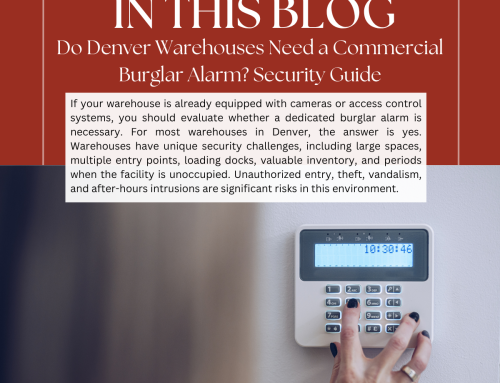
The system starts with sensors placed within the building and at each feasible access point. A sensor notifies the control panel when it senses an event, such as a door opening, a window breaking, or movement inside a protected area.
Sensor Activation Process
Different danger signatures are detected by different types of sensors. The physical opening of a protected barrier is detected by door and window contacts. Motion detectors detect movement in a predetermined region. The acoustic signature of shattered glass is detected by glass break sensors. A full system combines many types of sensors, each of which addresses a particular vulnerability.
Alarm Control Panel Response
The system’s brain is the control panel. All of the linked sensors send signals to it, which it then compares to preprogrammed parameters to decide the proper reaction. The panel starts the alarm sequence if the system is armed and a sensor is activated without a valid access code submitted during the entry delay window.
Alert Notifications
Strobe lights, push messages to certain mobile devices, automated communication to a professional monitoring center, and local auditory alarms are some examples of the alarm sequence. The configuration of the system determines the combination.
Monitoring Center Communication
When an alarm is set off, professionally monitored systems send a signal to a central monitoring station. Monitoring staff contact the company owner and law police in accordance with a predetermined reaction plan after verifying the occurrence often using integrated video feeds.
Main Components of a Commercial Burglar Alarm System
Door and Window Sensors
The baseline detection layer is made up of magnetic contact sensors that record the opening of any protected entry point. They are necessary for perimeter security, dependable, and reasonably priced.
Motion Recognition
Heat signals linked to human movement are detected by passive infrared motion detectors. By offering a supplementary detection layer within the perimeter, they safeguard internal zones.
Glass Break Sensors
Without coming into contact with the glass itself, storefronts, glass barriers, and facades with lots of windows are protected by acoustic sensors that are adjusted to the frequency of shattering glass.
Alarm Control Panels
Dozens to hundreds of sensors, various user codes, programmable zones, remote management, and interaction with other systems like cameras and access control are all supported by contemporary commercial panels.
Strobes and Sirens
Both visual and auditory alarms have two functions: they notify people in the vicinity of an incursion and make the environment unfriendly enough for most intruders to swiftly give up.
Mobile Management Applications
Leading manufacturers of commercial alarm platforms provide mobile applications that let managers and company owners activate and disarm the system remotely, get real-time notifications, and examine incident data from any place.
Types of Burglar Alarm Systems for Colorado Businesses
Wired Alarm Systems
Hardwired systems use actual cables to link sensors to the control panel. They are an excellent option for new construction or significant restoration projects where cabling may be run throughout the build, since they are very dependable and resistant to wireless interference.
Wireless Alarm Systems
Sensors and the panel communicate via encrypted radio frequency in wireless systems. They are more versatile in sensor location, quicker to install, and perfect for existing structures where it is not practicable to run additional cables.
Monitored Alarm Systems
Professional monitoring links the alarm system to a round-the-clock monitoring center that oversees owner notification and law enforcement dispatch. Monitored protection is the norm for the majority of commercial applications.
Smart Alarm Systems
Through cloud-connected control panels, smart platforms connect to mobile devices, building automation, and other security systems. Native features include analytics capability, real-time alerts, and remote management.
Hybrid Security Systems
By combining wired and wireless components, hybrid systems extend coverage to places where cabling is challenging and offer dependability on major entry points.
How Motion Detectors Help Prevent Business Break-Ins
The heat difference between a moving human body and the surrounding air temperature is detected by passive infrared motion detectors. The sensor detects a change in temperature when a human passes across the detection field and sends a signal to the control panel.
Passive infrared and microwave detection are combined in dual-technology sensors; both technologies must activate at the same time for an alarm to be sent. This significantly lowers the rates of false alarms in settings with tiny animals, HVAC drafts, or temperature swings.
For enterprises, interior motion protection offers an essential secondary detection layer. Motion detectors covering internal zones will turn on as soon as an intruder enters the area, even if a perimeter sensor is circumvented.
Benefits of Burglar Alarms for Colorado Businesses
Crime Deterrence: Before any breach is attempted, a sizable portion of potential burglars are discouraged by visible alarm signs and sensor gear. The majority of opportunistic thieves choose simpler targets over alarmed areas.
Faster Emergency Response: The amount of time an intruder has to operate within the building is significantly decreased by professionally monitored systems, which usually result in law enforcement response within minutes after alarm activation.
Reduced Financial Losses: Reduced theft and property damage are closely correlated with quicker reaction times. Losses from interrupted burglaries are far smaller than those from completed ones.
Lower Insurance Risks: Businesses using monitored alarm systems can receive rate discounts from a number of commercial property insurers. To assist with insurance filings, Security Surveillance System can offer documentation of system specs.
Improved Employee Safety: By offering a quick way to indicate an emergency, alarm systems safeguard workers who are working early hours, late shifts, or alone in buildings.
Smart Burglar Alarm Features Businesses Should Consider
Physical keypads are no longer the only control point for remote arming and disarming due to mobile app access. Instantaneous event notifications are sent to specific recipients via real-time alerts. AI-powered monitoring reduces false alarm costs and enhances response prioritizing by integrating with camera systems to enable video verification prior to the dispatch of law enforcement. Video verification lowers the possibility of incurring fines for making fraudulent police reports and is becoming more common in commercial monitoring contracts.
Integrating Security Cameras with Burglar Alarms
By integrating cameras, a burglar alarm becomes a comprehensive event management tool instead of just an alert system. Integrated camera systems instantly start recording the impacted area and provide real-time footage to the monitoring center when an alert goes off. Before sending out law enforcement, monitoring staff may visually confirm the incursion, which minimizes false alarm dispatches and guarantees that real incidents receive a fast priority reaction.
Post-incident investigation and evidence preparation are made simple by the automated indexing and linking of event-triggered recordings to the associated alarm event.
Common Causes of False Alarms and How to Prevent Them
False alarms upset business owners, put a burden on law enforcement, and may result in penalties from local authorities. Inadequate staff training on arming and disarming techniques, poor system maintenance, incorrect sensor placement, and environmental triggers like HVAC airflow close to motion sensors are the most frequent reasons.
Through precise sensor placement during installation, personnel training on system operation, and regular maintenance visits to maintain sensors calibrated and operating within specification, Security Surveillance System reduces the possibility of false alarms. Environmental false triggers are further reduced by smart alarm technologies, such as dual-tech motion sensors and AI-powered verification.
How Much Does a Commercial Burglar Alarm System Cost?
The size of the building, the number of access points, the quality of intrusion detection needed, and any integrations with other security systems are some of the variables that affect the price of a commercial burglar alarm system.
While bigger buildings may benefit from increased sensor coverage, motion detection, remote access capabilities, and integration with video surveillance or access control systems, smaller companies frequently need simple security focused on protecting doors, windows, and critical access points. To handle particular security issues, more complex situations usually need for tailored system architectures.
Many businesses use professional monitoring services that offer real-time warnings and round-the-clock response in addition to equipment and installation. Depending on the response procedures, reporting features, and service level chosen, several monitoring solutions may be available.
At Security Surveillance System, we assist businesses in choosing burglar alarm systems that fit their budget, operational requirements, and security goals. Our team creates scalable solutions that offer dependable security without adding superfluous features or equipment, guaranteeing long-term value and peace of mind.
Why Colorado Businesses Choose Security Surveillance System for Burglar Alarm Installation
Since 2006, Security Surveillance System has designed and installed commercial intrusion detection systems across the Denver metro region and Front Range. SSS has technical experience in wired, wireless, and hybrid alarm platforms, together with local understanding of commercial property types, area regulatory needs, and the unique security problems Colorado businesses face.
A site evaluation, a tailored system design, expert installation, and staff training are all included in every SSS installation. Contracts for ongoing maintenance ensure that systems continue to function dependably over time. Local professionals, not a distant contact center unfamiliar with your location, react promptly when servicing is required.
Frequently Asked Questions
How do burglar alarms identify trespassers?
Door contacts, motion detectors, and glass break sensors are among the several sensor types used by commercial burglar alarm systems. These sensors transmit signals to the central control panel when they detect an intruder.
When a burglar alarm is set off, what happens?
The alarm sequence, which usually consists of mobile push messages to specific contacts, local auditory and visual alerts, and communication to the professional monitoring center for dispatch coordination, is started via the control panel.
Are wireless burglar alarms reliable?
To ensure dependable operation, contemporary commercial wireless systems include battery backup and encrypted communication. Wireless solutions are just as reliable as wired installations for the majority of commercial buildings now in use.
Can burglar alarms be remotely monitored?
Indeed, mobile applications for smart commercial alarm solutions provide remote arming, disarming, event evaluation, and real-time alert management from any place.
Are burglar alarms operational without the internet?
Cellular-communicating alarm systems are resistant to both intentional line cutting and internet outages since they retain monitoring connectivity without depending on internet service.
How frequently should alarm systems be serviced?
Commercial alarm systems must undergo annual preventative maintenance assessments. For high-traffic areas or systems with a lot of sensors, SSS suggests semi-annual servicing visits.
When properly built, integrated, and maintained, commercial burglar alarms are among the most affordable security expenditures available to Colorado businesses. They continue to be a fundamental component of corporate security. To arrange a company security consultation and obtain a commercial alarm estimate customized for your establishment, get in touch with Security Surveillance System.
Conclusion
For businesses in Colorado, a burglar alarm system is a basic security necessity, not an extravagance. Every industry and market segment experiences break-ins, and the companies that recover the quickest are those with a system in place that identifies the intrusion early, notifies the appropriate parties right away, and produces a documented record that supports the subsequent insurance claim and investigation.
There is much more to modern business alarm systems than just door contacts and sirens. In order to create a holistic security environment that reacts more quickly and intelligently than any single-layer solution could, today’s platforms incorporate motion detection, glass break sensors, smart mobile management, video verification, and seamless connectivity to camera and access control systems.
Since 2006, Security Surveillance System has designed and installed commercial burglar alarm systems for companies in Colorado. SSS provides the local knowledge, skilled installation standards, and continuous maintenance assistance that out-of-state alarm companies just cannot match, from tiny retail stores in Aurora to warehouses, medical institutions, and office buildings throughout the Front Range.
Don’t wait for a break-in to find out where your security gaps are. To arrange a business security consultation and obtain a burglar alarm estimate tailored to your facility, risk tolerance, and financial constraints, get in touch with Security Surveillance System right now. To talk with a local Colorado security expert, give us a call or go to www.ssscamera.com