How Do PTZ Cameras Protect Denver Commercial Sites?
Monitoring a large commercial property is a complex undertaking that cannot be solved by simply pointing a camera at the front door. Warehouses, parking lots, office campuses, and industrial facilities all have wide, open, and often unpredictable areas that a single fixed camera cannot cover. PTZ cameras are an effective solution for this.
PTZ stands for pan, tilt, and zoom, and these cameras are built to move sweeping across a property, zooming in on activity, and adjusting their field of view in real time. PTZ technology provides a level of flexibility that fixed cameras alone cannot match for businesses in Denver managing warehouses, parking lots, office campuses, industrial facilities, and retail properties. When designed and installed correctly, a PTZ system can extend visibility across large areas while still capturing the kind of detail needed to identify people, vehicles, and activity from a distance.
What is a PTZ security camera?
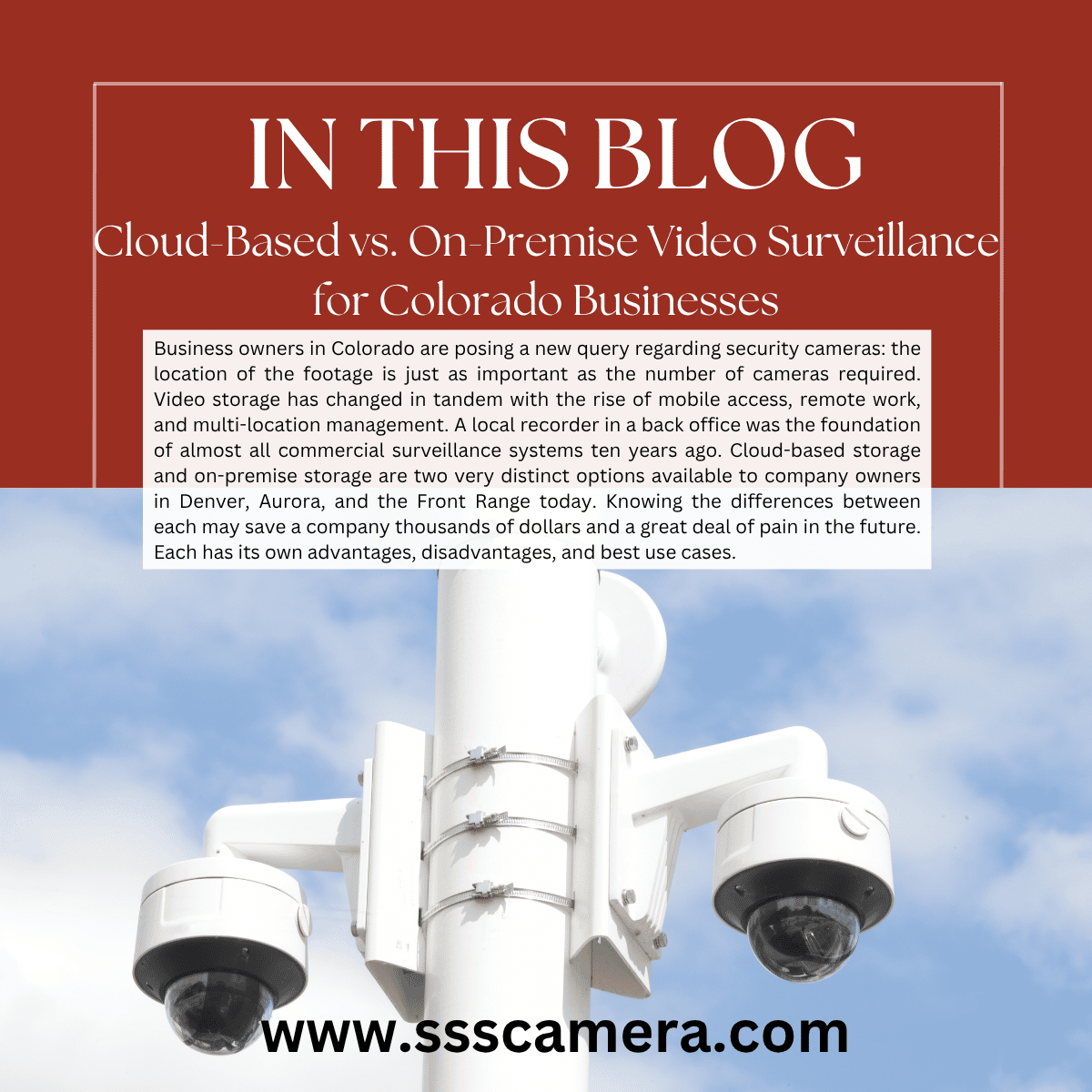
A pan-tilt-zoom (PTZ) security camera is a camera that can pan, tilt, and zoom either automatically or through operator control.
- Pan moves the camera horizontally, enabling it to monitor different directions from a single mounting point.
- Tilt is a function that allows the camera to be adjusted vertically, thereby altering the viewing angle up or down.
- Zoom is an effective tool that allows users to see distant activity more clearly. It helps to identify details that would otherwise be too far away to see clearly.
In contrast to a traditional fixed security camera, which remains focused on a single, unchanging view, a pan-tilt-zoom (PTZ) camera has the ability to reposition itself in order to follow activity, cover multiple zones, or focus in on a specific area of concern. This makes it a fundamentally different tool, one built for coverage and flexibility rather than a single fixed vantage point.
How Do PTZ Cameras Work?
Pan and Tilt Movement
PTZ cameras allow operators or automated programming to change the camera’s viewing direction when required. In many commercial settings, a single PTZ camera can effectively survey a wider area than a fixed camera would be able to cover from the same mounting location, simply because it isn’t locked into one angle. Additionally, many systems offer preset viewing positions, enabling the camera to automatically focus on predefined points of interest, such as a loading dock, a gate, or a parking lot entrance, with a simple command.
Optical and Digital Zoom
It is important to note that not all zooms are the same. The camera’s actual lens elements are used by optical zoom to magnify an image without any loss in quality. In contrast, digital zoom simply crops and enlarges the existing image, which can result in a loss of clarity at higher magnifications. For commercial applications, optical zoom is often the preferred option, particularly when identifying activity at greater distances across a parking lot, near a gate, or along the edge of a large outdoor space.
Automated Camera Movement
Many PTZ systems offer preset tour functionality, enabling the camera to automatically cycle through a series of designated points according to a set schedule. This type of automation helps to expand the coverage area across a property while eliminating the need for constant manual operation. It is important to note, however, that automated movement should support a broader security strategy rather than serve as the sole method of monitoring a site.
In what ways do PTZ cameras benefit Denver commercial properties?
Denver’s commercial landscape encompasses a diverse array of properties that pose significant monitoring challenges:
- Large parking areas
- Warehouses and distribution centers
- Commercial campuses
- Construction sites
- Loading docks
- Building perimeters
- Large retail properties
Each of these environments has open, expansive areas where fixed cameras alone often leave coverage gaps. PTZ cameras are designed to address these challenges.
In what ways do PTZ cameras benefit Denver commercial properties?
- Monitor Large Areas Effectively
Strategically placed PTZ cameras can provide comprehensive coverage of expansive outdoor spaces, eliminating the need for multiple fixed cameras. In many commercial layouts, PTZ units are most effective when used in conjunction with fixed cameras, providing comprehensive coverage where a static view is insufficient.
- Focus on Security Incidents
In the event of an incident occurring at a distance from the camera, the ability to zoom in is of the utmost importance. PTZ cameras can capture closer, more detailed views of people or vehicles, which supports more effective incident investigation after the fact.
- Monitor parking lots and perimeters
Pan-tilt-zoom (PTZ) cameras are particularly well suited to tracking vehicle activity across a parking lot or monitoring the perimeter of a property. Many models also offer nighttime monitoring capabilities, extending visibility well past daylight hours when supported.
- Enabling Remote Security Monitoring
When utilized with the appropriate platform, pan-tilt-zoom (PTZ) cameras can facilitate live remote viewing and, in many cases, remote PTZ control. This enables authorized users to adjust the camera’s position from a mobile device or a centralized monitoring station.
- Track Moving Activity
Certain pan-tilt-zoom (PTZ) cameras are equipped with auto-tracking capabilities, enabling them to monitor and follow movement across a designated area. Performance can vary significantly depending on the specific camera technology and the manner of installation. It is therefore advisable to consult a security integrator directly to ascertain whether this capability will meet a specific need.
- Improve Incident Investigation
In the aftermath of an incident, PTZ cameras empower security teams to swiftly focus on crucial footage. These cameras enable the review of extensive recordings and identification of critical visual details such as license plates, faces, and clothing, which might otherwise go unnoticed in a more conventional fixed shot.
PTZ Cameras vs. Fixed Security Cameras: Which option would be preferable?
There is no definitive evidence to suggest that one technology is superior to the other. In the majority of commercial surveillance systems, PTZ and fixed cameras are most effective when used in combination.
When Fixed Cameras Make More Sense
Fixed cameras are the ideal solution when a property requires constant, uninterrupted monitoring of a specific location, such as an entrance, a doorway, or a cash register area. Due to their static nature, they ensure uninterrupted coverage without the need for pre-set schedules or manual repositioning.
When PTZ Cameras Are the Better Choice
PTZ cameras are particularly effective in large open areas, parking lots, perimeters, and expansive outdoor facilities, where active, flexible monitoring is essential.
Why a Hybrid Surveillance System Can Be More Effective
Fixed cameras provide dedicated, reliable coverage of critical points, while PTZ cameras offer flexible, wide-reaching monitoring. Combining both approaches is a more effective way of reducing coverage gaps than relying on either technology alone.
What features should Denver businesses look for in pan-tilt-zoom (PTZ) cameras?
- High optical zoom
- High-resolution video
- Night vision
- Wide dynamic range
- Weather-resistant housing
- Automated tracking
- Preset positions
- Intelligent video analytics
- Remote management
- Integration with NVR/VMS platforms
How can pan-tilt-zoom (PTZ) cameras be integrated with other security systems?
Video Surveillance Systems
PTZ cameras have the capacity to integrate with fixed cameras under a centralized video management platform. This facilitates event-based recording and a more comprehensive overall view of a property.
Access Control Systems
When used in conjunction with access control measures, pan-tilt-zoom (PTZ) footage can be linked to specific access events. This capability facilitates the review of activity around secured entrances and supports investigations into any potential irregularities.
Burglar Alarm Systems
Integration with a burglar alarm system can allow PTZ cameras to trigger recording automatically when an alarm event occurs. This provides visual verification and improves overall situational awareness.
What is the cost of PTZ security cameras in Denver?
The pricing of PTZ camera systems varies significantly based on several factors, including:
- Camera specifications
- Optical zoom capability
- Number of cameras
- Mounting requirements
- Cabling and networking
- Recording and storage needs
- Analytics features
- Installation complexity
- Integration with existing security equipment
Due to the unique nature of each commercial property, there is no single price point that can be applied universally. A property-specific assessment is the only reliable way to determine actual costs.
Why Choose Security Surveillance System (SSS) for PTZ Camera Installation?
- Customized commercial surveillance design
- Professional camera placement
- PTZ and fixed-camera integration
- Solutions built for Denver businesses
- Ongoing maintenance and support
Frequently Asked Questions
What is a PTZ camera, and how does it function?
A pan-tilt-zoom (PTZ) camera provides a flexible and comprehensive monitoring solution for commercial properties, allowing it to move around and cover a larger area effectively.
Are PTZ cameras suitable for large commercial properties?
Yes, they are particularly effective for warehouses, parking lots, industrial facilities, commercial campuses, and other large outdoor spaces where a single fixed angle would not suffice.
Can PTZ cameras automatically track people or vehicles?
Some models do offer auto-tracking capabilities, but this feature largely depends on the camera’s technology and analytics. It’s important to choose equipment specifically designed for the intended application.
How do PTZ cameras compare to fixed security cameras?
PTZ and fixed security cameras serve different purposes, and it is generally advisable for commercial properties to use a combination of both rather than relying on just one type.
Can PTZ cameras be controlled remotely?
Yes, many PTZ cameras can be operated remotely. Video management platforms that support this system typically allow for both remote viewing and remote PTZ control.
How well do PTZ cameras function at night?
Many PTZ cameras are equipped with infrared or low-light technology, though their actual performance at night will depend on the camera’s specifications and the lighting conditions on-site.
What is the maximum range of a PTZ security camera?
The optimal viewing distance is influenced by various factors, including resolution, optical zoom, lens specifications, lighting conditions, and environmental factors.
What is the cost of installing a PTZ camera for a business in Denver?
The installation cost can vary based on the equipment needed, the complexity of the installation, networking requirements, storage needs, and integration with existing security systems. For the most accurate estimate, a property-specific assessment should be conducted.
Conclusion
PTZ cameras provide Denver commercial properties with a level of flexible, long-range surveillance that fixed cameras alone cannot provide. They are most effective when strategically positioned across a property and combined with fixed cameras and other security technologies, based on the specific risks and layout of the site.
Call to Action
If you manage a commercial property in Denver and would like to explore whether pan-tilt-zoom (PTZ) cameras are the right fit for your needs, please contact Security Surveillance System for a professional commercial surveillance assessment. Our team is well-versed in recommending the most suitable PTZ camera solutions, designing bespoke systems for your property, and providing comprehensive installation guidance.