How to Choose Outdoor Cameras for Colorado Businesses
Choosing an outdoor security camera is not the same as choosing one for an indoor space, so it is important to consider the differences between the two when making your selection. Outdoor cameras face challenges such as the sun, wind, snow, temperature swings, and long viewing distances that indoor units never encounter. For businesses in Colorado, this is particularly important. A single property may experience bright, high-altitude sunshine in the afternoon, a hailstorm an hour later, and freezing temperatures overnight. A camera that isn’t built for this kind of variability will underperform precisely when it is needed most.
Camera placement, image quality, durability, and night-time performance all affect whether footage will be usable in the event of an incident. To summarize: when choosing the best outdoor security camera for a business in Colorado, the following factors should be considered: weather resistance, the required viewing distance, lighting conditions, resolution, camera placement, analytics capabilities, storage needs, and how well the system integrates with existing security infrastructure.
What should businesses consider before buying outdoor security cameras?
Before comparing camera models, it helps to define the scope of the project. Key factors include:
- Property size and layout
- Specific security risks (theft, vandalism, unauthorized access, liability concerns)
- Planned camera locations
- Required viewing distance for each location
- Day and night-time lighting conditions
- Weather exposure at each mounting point
- Existing security infrastructure already in place
- Room for future expansion as the property or business grows
These factors determine the resolution, lens choice, housing rating, and camera type.
Which security camera features matter most in Colorado?
Weatherproof and outdoor-rated housing
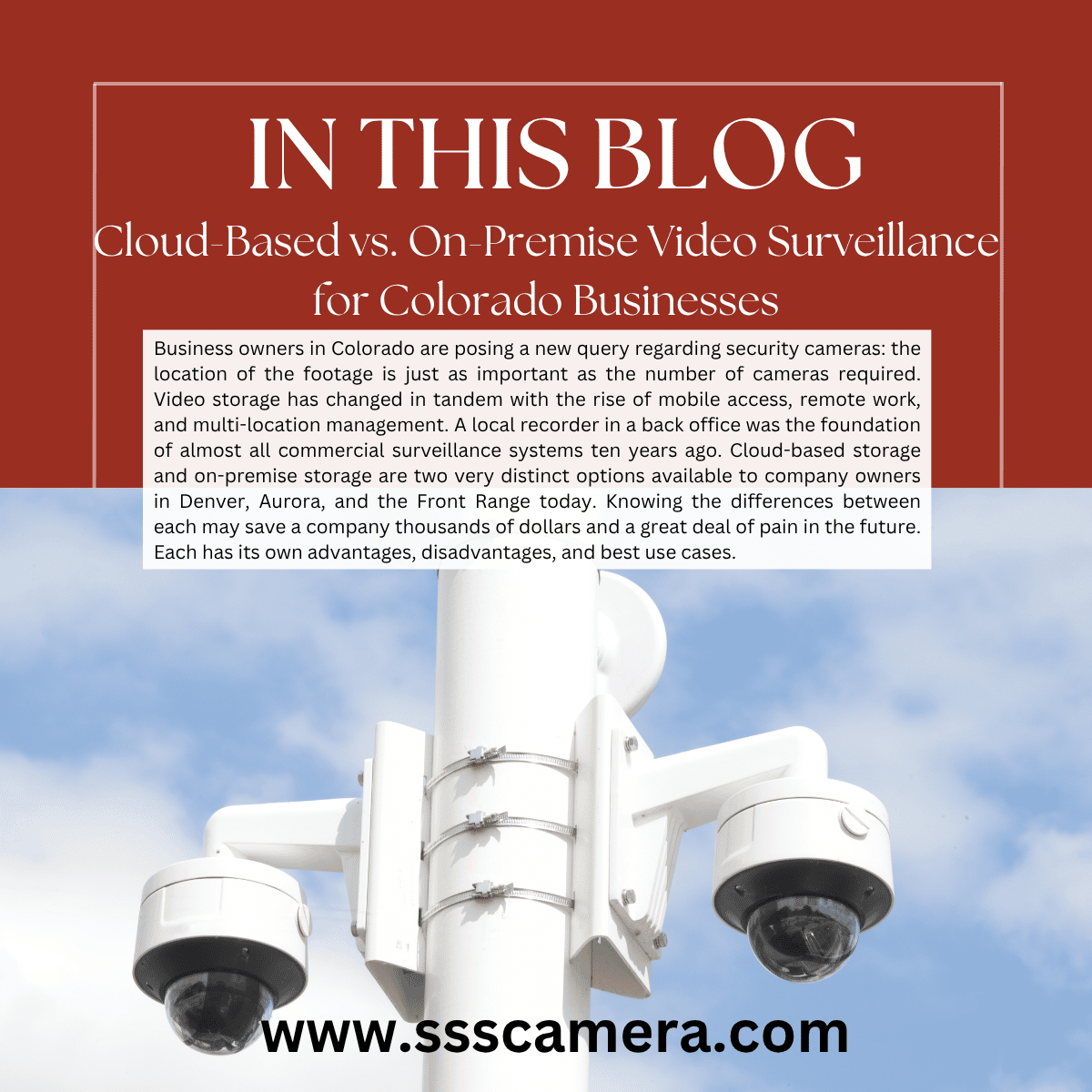
Outdoor cameras need housings that can withstand rain, snow, dust, and repeated temperature changes. Manufacturers indicate this level of protection using IP (Ingress Protection) ratings; the most common for outdoor commercial cameras are IP66 and IP67. Businesses should verify the actual rating rather than relying on marketing terms such as ‘weatherproof,’ as these have no standardized meaning. Proper installation is also important; even a well-rated camera can underperform if mounted or sealed incorrectly.
Temperature and climate protection
Colorado’s climate can swing between freezing winter mornings and intense summer heat, sometimes within the same week. Outdoor cameras should have a manufacturer-specified operating temperature range that covers both extremes. Consumer-grade equipment is often not rated for this kind of temperature cycling, which is one reason why commercial-grade hardware is generally recommended for properties in Colorado.
Impact and Vandal Resistance
Cameras installed in publicly accessible areas, such as car parks, entrances, and low-mounted positions, are at a higher risk of tampering or impact damage. IK ratings measure a camera’s resistance to physical force. Businesses with cameras within the public’s reach should consider this alongside weatherproofing when selecting their equipment.
What Resolution Do Outdoor Business Cameras Need?
1080p vs. 4MP vs. 4K
A higher resolution captures more image detail, which is important when viewing from a distance or when identification is a priority. However, the resolution of each camera should be matched to its specific distance and purpose rather than being maximised across the board. For example, a wide parking lot view may benefit from 4K, while a short-range entrance camera may perform well at a lower resolution.
Choosing the Right Lens
Lens selection is just as important as megapixel count. Wide-angle lenses cover broad areas but reduce detail at a distance. Narrower lenses, on the other hand, are better suited to long-range viewing of a specific zone. Matching the type of lens to the intended use of each camera prevents wasted resolution and blind spots.
Identifying Faces and License Plates
Reliable identification depends on strategic placement, the right height, angle, and distance, rather than just a higher-resolution sensor. For capturing licence plates specifically, a dedicated camera positioned for that purpose typically performs more reliably than a general-purpose surveillance camera.
How important is night vision for Colorado businesses?
Infrared Night Vision
Infrared (IR) illumination enables cameras to capture usable footage in total darkness, making it valuable for use at entrances, in car parks, at loading bays and around the perimeter of buildings. However, it’s important to note that a manufacturer’s published IR range is measured under ideal conditions and may not reflect real-world performance when weather, reflective surfaces, or obstructions are taken into account.
Low-light and full-color cameras
Some cameras use larger sensors to capture full-color video in low ambient light rather than switching to black-and-white IR mode. This can be useful when color detail is important, for example, when identifying a vehicle or clothing, but performance still depends on the amount of available light at the site.
Wide Dynamic Range
WDR technology helps cameras balance bright and dark areas within the same frame, which is useful at entrances and in car parks, for example, where headlights or direct sunlight can otherwise wash out or darken the image.
Which Types of Outdoor Security Cameras Are Best for Businesses?
Outdoor Bullet Cameras
These are well suited to perimeter and directional coverage, and their visible design also serves as a deterrent.
Outdoor dome cameras
These are a compact, tamper-resistant option, often used at entrances and other public-facing locations.
PTZ cameras:
These cameras allow operators to actively monitor large outdoor areas and zoom in on specific activity. They work best as a complement to fixed cameras rather than a replacement for them.
Multi-sensor and panoramic cameras
These can cover wider areas with fewer camera positions in the right environment, which is useful for car parks and other large open spaces.
License Plate Recognition Cameras
Built specifically for vehicle and plate capture, these cameras are best used at entry lanes, parking entrances, and other vehicle-focused surveillance points.
Where should Colorado businesses install outdoor cameras?
Common placement points include:
- Building entrances
- Employee entrances
- Parking lots
- Loading docks
- Gates
- Property perimeters
- Outdoor storage areas
- Dumpster and service areas
- Driveways and access roads
Our professional camera design service takes into account mounting height, viewing angle, lighting, distance, and blind spots, as well as seasonal environmental conditions in Colorado. Security Surveillance System specifically factors in sun angle, snow glare, temperature cycling, and sightlines when designing perimeter surveillance for local properties.
Should Businesses Choose AI-Powered Outdoor Cameras?
Person and vehicle detection
AI analytics can distinguish between people and vehicles and general motion, reducing unnecessary alerts where the feature is supported.
Line-crossing and intrusion detection:
Businesses can establish virtual boundaries and receive alerts when activity that has been configured crosses them.
Smart search and event review:
AI-assisted search tools help teams find relevant footage faster, reducing the time spent scrolling through hours of recordings.
How should outdoor cameras be integrated with other security systems?
Access control
Video can be paired with controlled entrances, allowing footage to be reviewed alongside access events.
Burglar alarms:
Cameras can be used to visually verify alarm activations and improve overall situational awareness during an event.
Intercom systems:
By combining video, communication, and access management, staff can verify visitors at gates and entrances before granting entry.
What are the biggest mistakes to avoid when choosing outdoor cameras?
- Buying cameras based on price alone
- Ignoring night visibility requirements
- Choosing the wrong lens for the application
- Installing cameras without accounting for blind spots
- Using indoor-rated equipment outdoors
- Overlooking network and storage requirements
- Failing to plan for future expansion
Why choose Security Surveillance System (SSS) for outdoor camera installation in Colorado?
SSS designs customized outdoor surveillance systems for Colorado businesses, using commercial-grade equipment and professional placement strategies. With expertise in perimeter surveillance and seamless integration with alarms, access control and intercom systems, as well as solutions built around Colorado’s climate, SSS provides ongoing service and support long after installation.
Frequently Asked Questions
Which outdoor security cameras are the most effective for businesses in Colorado?
The selection of the appropriate camera is contingent upon considerations such as weather resistance, resolution, night vision performance, lens selection, analytics needs, and the specific requirements of the property.
What IP rating is appropriate for an outdoor security camera?
IP66 and IP67 are common outdoor ratings, indicating protection against dust and varying degrees of water exposure. Businesses should evaluate the actual environmental conditions at each mounting location rather than relying on the term “weatherproof” alone.
Are 4K security cameras worth it for outdoor business surveillance?
While 4K technology can offer significant added detail, particularly at longer distances, factors such as lens choice, lighting, and placement remain crucial for ensuring optimal image quality.
Which type of outdoor camera is the most suitable for a parking lot?
Each camera type, including fixed, panoramic, PTZ, and license plate cameras, has its own intended use. Determining the most suitable combination of these cameras depends on factors such as the size of the lot and the specific surveillance objectives.
Do outdoor security cameras function in snow and freezing temperatures?
Yes, provided the equipment carries an appropriate temperature rating, uses a weather-resistant housing, and is properly mounted and installed.
How far can an outdoor security camera see at night?
The usable nighttime viewing distance is influenced by various factors, including lens type, resolution, IR illumination, ambient lighting, weather, and placement. These factors should be considered in addition to the published specification.
Can outdoor security cameras integrate with alarms and access control?
Yes, integrated systems have the capacity to link video footage with alarm events and controlled entry points, thereby offering a more comprehensive view of security.
What is the cost of installing outdoor security cameras in Colorado?
The cost of the system depends on several factors, including the number of cameras, the type of equipment, cabling, mounting, networking, storage, analytics, and the complexity of the overall installation.
Conclusion
There is no single “best” outdoor security camera; the right choice depends on a property’s environment, layout, security risks, and desired level of visibility. Colorado businesses should consider a range of factors when selecting a security camera, including weather resistance, resolution, lighting, camera type, and integration needs.
Call to Action
Are you interested in enhancing the security of your property’s outdoor areas? Contact Security Surveillance System (SSS) for a professional outdoor camera assessment, tailored equipment recommendations, and a system design built around your property’s specific layout and Colorado’s climate.